
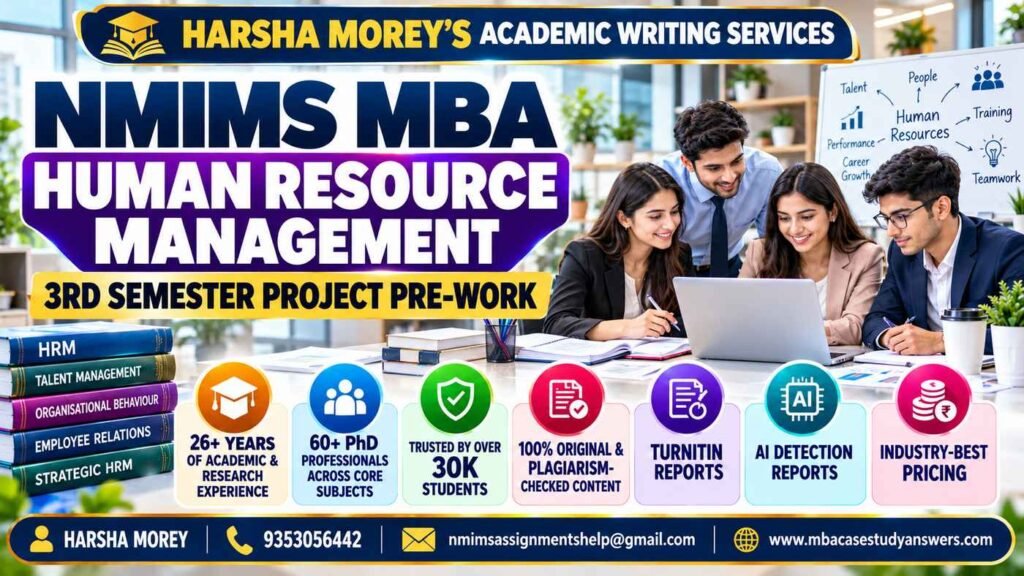
NMIMS MBA in Human Resource Management 3rd Semester Project Pre-Work
Looking for NMIMS MBA in Human Resource Management 3rd Semester Project Pre-Work?
Harsha Morey’s Academic Writing Service offers research-topic guidance, planning support, organised documentation, and personalised academic mentoring. The service helps learners frame a people-management question, identify suitable evidence, and prepare a structured project plan that can be reviewed against the applicable university instructions.
NMIMS Semester III Project Pre-work: Key Guidance for Students
Students preparing for the NMIMS project should use Semester III to make early decisions about their project format and title. This pre-work stage is optional, but strongly recommended as preparation for the mandatory project in Semester IV.
The project has two stages. Semester III Project Pre-work is a zero-credit stage. Semester IV Project is mandatory and carries 6 credits. Students should plan to complete the required Semester IV project regardless of whether they participate in pre-work.
During Semester III, students must select one of three approved formats. A research-based project involves a literature review to build a research argument. A business plan identifies a gap or opportunity and proposes a viable business solution. A problem-solving proposal addresses a specific issue in the student’s department or organisation.
Students are also required to submit a project title. The title should be clear, focused and directly related to the selected area of specialisation. The listed specialisations include Finance, HR, Marketing, Operations & Data Science, Information Technology, Business Analytics and Business Management.
Before submission, students should check that the title communicates the intended subject and that the project format matches the objective. A topic that is too broad or unrelated to the chosen field may need refinement. Students should make the scope understandable without adding unnecessary detail.
A faculty mentor reviews the submitted title to confirm its alignment with the selected specialisation. The mentor will provide feedback indicating whether the title is appropriate or requires revision. Students should use the review to make the proposed direction more precise.
The purpose of Semester III pre-work is to help students begin the project journey early. By choosing a suitable format, preparing a relevant title and responding to mentor feedback, students can approach the mandatory six-credit Semester IV project with a more considered plan.
Human Resource Management Project Pre-Work: Investigating People and Workplace Practices
Human Resource Management examines how organisations attract, develop, support, and retain people while pursuing business objectives. A project pre-work plan helps narrow a workplace concern into a researchable question. Possible areas include employee engagement, learning and development, recruitment experience, performance appraisal, work-life balance, retention, diversity and inclusion, and the use of technology in HR processes. A useful project focuses on a defined group or setting and considers both organisational outcomes and employee experience.
Potential topics include employee perceptions of onboarding, training effectiveness in a particular role group, factors associated with intention to stay, employee attitudes towards performance feedback, or perceptions of hybrid-work arrangements. A topic should be selected with sensitivity to access, confidentiality, and the ability to gather evidence without exposing individuals. Avoid collecting unnecessary personal information. If primary research is planned, consider whether participants can respond voluntarily and whether their identities can be protected.
The project plan should set out a problem statement, objectives, research questions, a brief rationale, and a suitable method. HR research may use anonymous surveys, semi-structured interviews, policy-document analysis, published research, or a case study. Each method has strengths and limitations. A survey can identify patterns in perceptions, while interviews may provide more context about why people respond in particular ways. The method should fit the question and be feasible within the project timeline. Any organisational permissions or ethical safeguards should be considered before data collection.
Workplace findings need careful interpretation because employee experiences can be shaped by role, manager, tenure, workload, organisational culture, and wider economic conditions. A small sample should not be presented as representative of every employee. Survey questions should be neutral and avoid leading language. Interview notes and organisational documents should be handled confidentially. Where the data shows a relationship between training and performance perceptions, explain what the evidence can support and what remains uncertain.
An HR-focused analysis may draw on concepts such as employee engagement, psychological safety, job satisfaction, competency development, talent management, or organisational commitment. Use a framework only where it clarifies the research question. For example, a study of onboarding can assess clarity of role expectations and access to support, whereas a training study may examine perceived relevance, application of learning, and follow-up. Recommendations should be practical, evidence-led, and sensitive to employees as well as organisational requirements.
Planning Your Third-Semester Project Pre-Work
Good academic documentation makes the reasoning easy to follow. Use headings that reflect the purpose of each section, define important terms, and explain why each method or source is relevant. Keep a record of sources as you research instead of trying to reconstruct citations at the end. Tables and figures should be numbered, titled, and discussed in the text; they should contribute to the argument rather than repeat it.
Project quality depends on the relationship between the problem, objectives, evidence, analysis, and conclusion. If a section does not help answer a research question, reconsider its place in the document. Avoid unsupported claims, broad generalisations, and conclusions that are stronger than the data permits. A concise limitation section demonstrates awareness of the boundaries of the study and helps readers understand how the findings may be used.
Students remain responsible for understanding their project, checking the university’s rules, and ensuring that their final submission reflects their own learning and complies with academic-integrity requirements. Academic support is most useful when it improves research planning, clarity, source use, structure, and presentation. Keep records of decisions and drafts so that the reasoning behind the final project remains transparent.
Before drafting, read the relevant project instructions carefully and make a short checklist of required components. Confirm whether the pre-work asks for a topic proposal, objectives, literature review, methodology, timeline, or other specific elements. The article here is general planning guidance, not a substitute for the latest programme instructions. If a requirement is unclear, obtain clarification from the university before relying on an assumption.
A workable timeline divides the project into manageable tasks: topic confirmation, source review, research design, evidence collection, analysis, drafting, referencing, and final review. Leave time for revisions and for checking that every section answers the stated objectives. A simple schedule can reveal whether the chosen topic is too ambitious and whether the proposed data can realistically be obtained before the deadline.
Why Choose Us?
HARSHA MOREY’S Academic Writing Service emphasises subject-specific guidance, organised research planning, clear documentation, and support tailored to the project scope. The following service features can help students plan their work and review their documents more systematically:
26+ Years of Academic & Research Experience
Benefit from long-standing experience with academic planning, research documentation, and the organisation of complex project material. The appropriate scope and support arrangement should be discussed before work begins. For this human resource management topic, the emphasis should remain on a well-defined question, appropriate evidence, and conclusions that match the analysis.
60+ PhD Professionals Across Core Subjects
A multidisciplinary team can help connect a project with the right subject area and research perspective. Expertise should be matched to the topic and the requirements that the student has verified.
Subject-Specific Academic Support
Guidance can be shaped around the chosen specialisation, the research question, the available evidence, and the document requirements rather than relying on a generic project outline.
Original & Plagiarism-Checked Content
Support can focus on independent research development, clear attribution, responsible paraphrasing, and similarity review. No similarity score can guarantee a particular academic outcome; students should verify and understand every source used. For this human resource management topic, the emphasis should remain on a well-defined question, appropriate evidence, and conclusions that match the analysis.
Turnitin Similarity & AI Detection Reports
Reports may be available to support document review. Similarity and AI-detection tools have limitations and should be interpreted carefully; they do not replace sound citation practices or institutional rules.
Affordable & Competitive Pricing
Pricing can be discussed in relation to the topic, length, research complexity, and agreed deliverables. Confirm the scope, timeline, and any revision arrangements before proceeding.
Trending Project Topics for MBA Programmes
Topic suggestions can be explored across NMIMS MBA specialisations, NMIMS BBA, and NMIMS MBA Working Executive Programmes, subject to each programme’s applicable project guidelines. For this human resource management topic, the emphasis should remain on a well-defined question, appropriate evidence, and conclusions that match the analysis.
Research-Based Content & In-Depth Analysis
A stronger project links the research question to credible sources, a suitable method, careful analysis, and conclusions that follow from the available evidence.
Professional Formatting & Referencing
Consistent headings, tables, citations, reference lists, and document layout make a project easier to review. Follow the format and referencing style specified by the programme.
Personalised Project Guidance
Discuss topic selection, planning, methodology, structure, and presentation in line with the support agreed for the project and the student’s own academic responsibilities. For this human resource management topic, the emphasis should remain on a well-defined question, appropriate evidence, and conclusions that match the analysis.
Timely Delivery Commitment
A realistic schedule supports review and refinement. Deadlines and deliverables should be agreed in advance, with enough time reserved for the student’s own checks.
Dedicated Support & Quality Checks
A review process can help identify gaps in organisation, consistency, citations, and presentation before the document is finalised.
Industry-Best Pricing
Ask for a clear quote based on the project’s scope and complexity so that expectations about deliverables and costs are understood before work starts. For this human resource management topic, the emphasis should remain on a well-defined question, appropriate evidence, and conclusions that match the analysis.
Get Support for Your NMIMS MBA in Human Resource Management 3rd Semester Project Pre-Work
A well-prepared human resource management project begins with a focused problem, realistic objectives, an appropriate research method, and a clear plan for analysing evidence. Review the latest official programme requirements before finalising the topic or starting data collection. A careful pre-work stage can make later drafting more coherent and help identify practical limitations early.
Harsha Morey’s Academic Writing Service can discuss topic ideas, research planning, structure, formatting, and documentation needs. When making an enquiry, share the project title or area of interest, the instructions supplied by the university, expected deliverables, and the submission timeline. This helps establish a clear scope for any support requested.